


Hornbeam Hedging Plants
Carpinus betulus Hedge, Hornbeam Hedge
Hornbeam hedge plants are deciduous trees similar to Green Beech and can be trimmed into the most glorious of hedges. Hornbeam has oval shaped, mid to dark green leaves which have ridges and serrated edges. The leaves of a hornbeam hedge turn to rich oranges and yellows in the autumn. Hornbeam is easily grown as a hedge and does especially well on chalk and heavy clay soils. If Hornbeam hedges are trimmed in late summer, a large proportion of the crisp, dead leaves are retained well into winter. Hornbeam hedges will tolerate hard pruning, some partial shade, and are more suited to wet soils than Beech hedging. An excellent choice for a deciduous formal hedge. Please scroll further down the page for more information on Hornbeam Hedging plants.

What makes hornbeam a good hedge plant?
Hornbeam is a hardy and adaptable tree that makes a fantastic hedging plant. Hornbeam can thrive in clay, chalk and even damp soils. Hornbeam is deciduous but often retains many leaves into the Winter offering some Winter privacy. Hornbeam hedges are tolerant of pruning and even hard pruning and are ideal for creating formal or informal hedges. This wildlife friendly tree provides shelter and food for birds and insects attracting wildlife into your garden.
How fast does hornbeam grow?
Hornbeam is a relatively fast grown species growing around 30-60cm per year in good conditions.
When and how should I plant a Hornbeam Hedge?
The best time to plant a Hornbeam hedge is in the Autumn or early Spring. First clear away any grass, weeds or debris from the area you wish to plant your hedge, as these will compete for water and nutrients within the soil and may prevent your hedge from establishing quickly. Next, you should mark a line where you wish your hedge to grow and to ensure it grows straight and then dig a trench about 60cm wide by 30cm deep. Evenly space the plants along the line backfilling with the soil and firming the plants into place. A good layer of mulch after planting will retain moisture and help prevent weeds establishing. For more information on Planting a Hornbeam Hedge please look at our guide.
Is Hornbeam tolerant of Various Soils and conditions?
Hornbeam hedges are remarkably adaptable, capable of thriving in a wide range of soil types and conditions. They can tolerate clay, chalky, sandy, and loamy soils, making them suitable for almost any garden. Hornbeam hedges can also withstand both wet and dry conditions, which adds to their appeal for gardeners dealing with less-than-ideal planting sites. Hornbeam will also grow well in exposed, windy or urban sites. This hardy hedging plant is also partial shade-tolerant, meaning it can grow well in areas with dappled sunlight. However, for the best results, it is recommended to plant Carpinus betulus hedges in a sunny or partially shaded location.
How many Hornbeam hedge plants per metre?
Plant distancing will vary from between 30-60cm depending on the size of the plants and how long you are prepared to wait until you have a hedge at the desired height and density. If you want to establish a dense hedge more quickly, then you may wish to plant the Hornbeam plants a little closer to each other, although it is important to ensure light can reach and air can circulate each plant. If you want to establish a hedge of more than 90cm in thickness, plant two rows in a staggered pattern, spacing the rows 45 cm apart, and position each plant 90 cm from the next one. For more information on Hornbeam hedge plant spacing please refer to our guide.
Is Hornbeam Wildlife Friendly Hedging?
In addition to offering privacy and wind protection, Hornbeam hedges provide essential habitats for various wildlife species. The dense foliage creates a safe haven for nesting birds, while the catkin flowers that appear in late spring attract pollinators like bees and butterflies. In autumn, Hornbeam hedges produce winged seeds that serve as a valuable food source for birds and small mammals.
How often should I prune a Hornbeam hedge?
Hornbeam hedges should be pruned at least once a year to keep them looking and maintain density. For a more formal hedge, trimming twice a year mid-summer and early Autumn would be beneficial. Hard pruning will help to restore overgrown hedges but is best carried out in lare winter / early Spring before the new season’s growth. Hornbeam will tolerate hard pruning and this can rejuvenate overgrown hedges. For more information on trimming a Hornbeam hedge please refer to our guide.
Is hornbeam hedging a good alternative to a green beech hedge?
Hornbeam (Carpinus betulus) is a great alternative to a green beech (Fagus sylvatica) hedge. Here are some reasons why you might choose hornbeam:
- Adaptability: Hornbeam is highly adaptable to various soil types, including heavy clay soils, whereas beech prefers well-drained soil.
- Leaf Retention: Both hornbeam and beech retain their dead leaves during winter, providing some year-round privacy. However, hornbeam may hold onto its leaves slightly better in exposed sites.
- Growth Rate: Hornbeam tends to grow faster than beech, so it can establish a hedge more quickly.
- Hardiness: Hornbeam is generally more resistant to pests and diseases compared to beech.
Ultimately, both hornbeam and beech make excellent hedging plants, so your choice might depend on your specific garden conditions and preferences.
Growing Advice
- Deciduous Tree. Will hold some leaves over winter
- Features: Fast growing, Versatile
- Growth Rate: Medium – 30-60cm per annum
- Likes: full sun or partial shade
- Soil preference: Moist well drained soils
- Unsuitable for: Very heavy clay or waterlogged soil
- Hornbeam Hedge Planting Distances – 3 – 5 plants per metre – single row or 5- 7 plants per metre staggered double row
- Trimming: Late Summer
Further Info
Hornbeam / Carpinus Betulus Description
Hornbeam plants, known scientifically as Carpinus betulus, are a popular choice for creating beautiful, dense garden boundaries that offer privacy and seasonal interest. The European Hornbeam is a deciduous hedging plant native to Europe and Western Asia, making it an attractive and eco-friendly option for gardeners looking to incorporate native plant species into their landscapes.
Hornbeam hedging plants are often considered an excellent alternative to Beech hedging, as they share many similar characteristics. They provide a fast-growing, hardy, and low-maintenance solution for creating both formal and informal hedges. This versatile and popular hedging plant is not only aesthetically appealing but also serves various practical functions.
Hornbeam Hedge Plants
Hornbeam hedges are known for their ability to grow quickly and their hardiness, making them a popular choice for both formal and informal garden designs. For more information, check out our article on the best type of hedging or hedge plants.
Dense foliage and Hedge Screening
One of the most significant advantages of Hornbeam hedging is its dense foliage, which provides an effective natural screen for privacy. The vibrant green leaves are slightly serrated and oval, and they create a lush, thick barrier when the plants are grown closely together. Hornbeam hedges are particularly useful for blocking unwanted views, reducing noise, and acting as windbreaks, thanks to their wind-resistant nature.
Carpinus betulus hedges can be grown to varying heights, depending on the desired level of screening and the garden’s overall design. It is not uncommon to see Hornbeam hedges reaching heights of 6 to 12 feet, or even higher for those seeking increased privacy.
Types of Hornbeam Hedging grown and supplied by Hedging UK
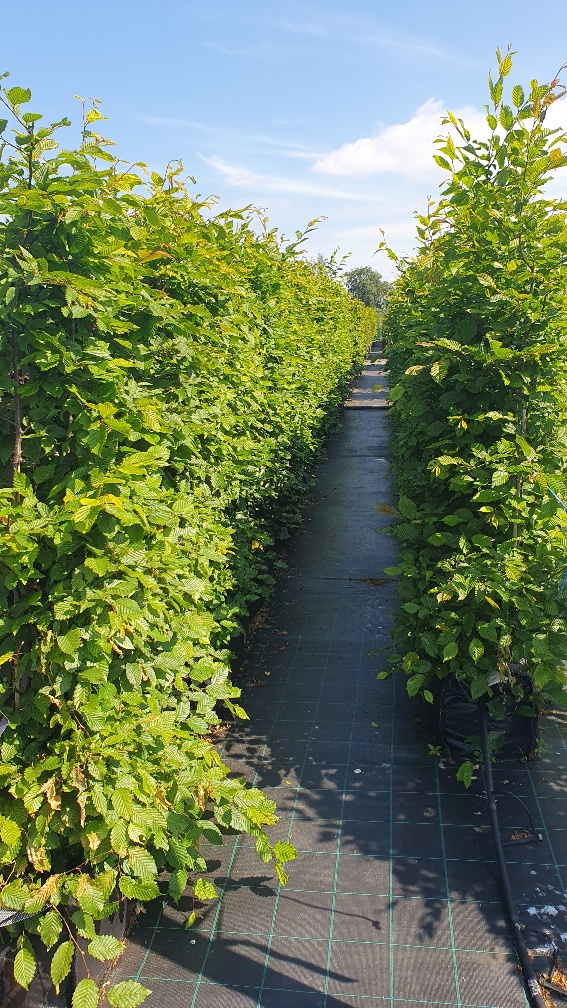
We grow Hornbeam hedging plants on our nursey primarily as an Instant hedge in 90L troughs each measuring 1 metre in length. Available at different heights throughout the year. Each trough contains a specific number of Hornbeam plants that have been grown together in a pot with the roots interwoven and the tops trimmed to form into a hedge. The instant hedges are sold as a block of hedge 1 metre wide, meaning that if your hedge is to be 10 metres long then you require 10 instant hedge units.
The Benefits of Hornbeam Hedging
There are several benefits to planting hornbeam plants in a garden or landscape:
- Privacy: Hornbeam hedging can be dense and tall, making them an excellent choice for creating privacy screens. They can help block out noise and provide a sense of seclusion in your outdoor space.
- Windbreaks: Hornbeam hedges can also serve as effective windbreaks, providing shelter for other plants and helping to prevent soil erosion.
- Aesthetics: The formal appearance of hornbeam hedges can add structure and visual interest to a garden or landscape. They can be trimmed into various shapes and sizes, including topiary, which makes them an excellent choice for formal gardens.
- Wildlife Habitat: Hornbeam trees produce nuts that provide a food source for birds and small mammals. The dense foliage of the hedge can also provide shelter for wildlife.
- Low Maintenance: Hornbeam hedge plants are relatively low maintenance once established. They require pruning once or twice a year to maintain their shape and size and the plant can tolerate high winds and a range of soil types.
- Longevity: Hornbeam hedges are long-lived and can provide an attractive and functional feature in a garden or landscape for many years.
Planting Hornbeam Hedges
When planting a Hornbeam hedge, it is essential to prepare the site well by removing any weeds and incorporating organic matter into the soil. This will help to improve soil structure and provide the roots of the hornbeam plants with the necessary nutrients for optimal growth. Please refer to our advice on How to plant a hedge and our Hedge Plant Spacing Advice pages for more information.
Pruning and shaping Hornbeam Hedges
Hornbeam hedges respond well to pruning and shaping, allowing gardeners to create hedges that are either formal and neatly clipped or more informal and relaxed in appearance. For a formal hedge, it is recommended to prune Hornbeam hedges twice a year – once in mid-summer and again in late summer or early autumn.
Informal hedges, on the other hand, can be pruned less frequently – once a year or even every other year, depending on the desired level of tidiness. Regular pruning not only keeps Hornbeam hedges looking neat but also encourages denser growth, providing a more effective barrier. More information on pruning can be found in our Hedge Pruning and Maintenance Guide.
Hornbeam Hedge Care
Caring for a Hornbeam hedge is relatively straightforward, making it an ideal choice for gardeners seeking a low-maintenance option. In addition to regular pruning, Hornbeam hedges benefit from an annual application of well-rotted organic matter or compost, which helps to maintain soil fertility and promote healthy growth of hedge plants.
Mulch the base of the hedge with organic material, such as bark chips or leaf mould. This will help the root system retain moisture and suppress weeds. During the first few years after planting, it is essential to water your Hornbeam hedge plants regularly, particularly during dry spells, to encourage deep root growth and establish a strong, healthy hedge.
Autumn Colour and Seasonal Interest of Hornbeam Hedges
One of the standout features of Hornbeam hedging is its ability to provide seasonal interest throughout the whole year. In spring, the fresh green leaves unfurl, followed by the appearance of delicate catkin flowers that attract pollinators. As the warmer months progress, the foliage matures into a rich, deep green, providing an attractive backdrop for other garden plants and features.
As autumn approaches, Hornbeam plants undergo a stunning transformation. The leaves change colour, taking on hues of golden yellow and warm orange, creating a breath-taking display that adds visual interest to the garden. These autumnal colours remain on the hornbeam hedge plants throughout the winter months, gradually drying and curling before falling, allowing for a fresh burst of green growth in the Spring.
Pleached Hornbeam
For those seeking a more formal and architectural look, pleached Hornbeam is an excellent choice. Pleaching is a traditional technique that involves training the branches of trees to grow horizontally along a framework, creating a living wall or screen. Pleached Hornbeam hedges are often used to create elegant garden rooms, define outdoor spaces, or provide additional privacy.
In conclusion, Hornbeam hedge plants offer a versatile, attractive, and practical solution for garden boundaries, privacy screening, and wind protection. With their dense foliage, seasonal interest, and wildlife-friendly characteristics, they are an ideal choice for creating a beautiful and functional garden landscape. Whether grown as a formal or informal hedge, Hornbeam hedges provide an excellent alternative to more traditional hedging options and can be easily maintained with regular pruning and care. By incorporating a Hornbeam hedge into your garden design, you can enjoy the year-round benefits of this hardy, adaptable, and visually appealing plant.
For further information on Hornbeam / Carpinus Hedging plants please refer to our Hornbeam species guide and our blog article on Hornbeam Hedging Plants
Call Hedging UK Today.
We at Hedging UK are renowned for being a welcoming, family-run company that specialises in producing high-quality hedging plants. Our own nursery in Holmeswood, Lancashire, grows all of our Hornbeam hedge plants outdoors, resulting in sturdy plants that take little time to establish. Through our mail order service, you may buy our hedge plants at wholesale prices all over the United Kingdom. Landscapers, local councils, garden centres, tree surgeons, schools, and private clients are among our customer base. Because of our market experience, we are able to provide the highest quality hedging plants at competitive prices and with a service to match.
Our nursery is located in Holmeswood, Lancashire in the north west of England and is not open to the general public. Whilst the nursery is predominantly a mail order business, customers are welcome to come and see our range of hedging plants and purchase plants at the nursery, but please do so by appointment only, contact Hedging UK today.