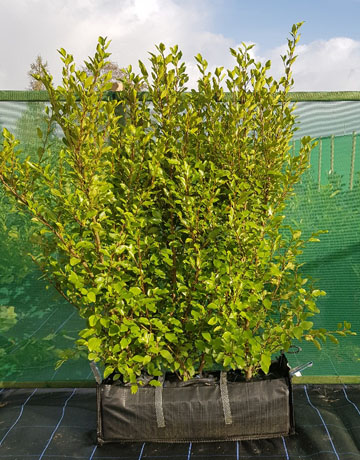
When to Plant a Griselinia Hedge

When to Plant a Griselinia Hedge

The best time to plant a Griselinia hedge is usually in autumn or spring, when the soil is moist, temperatures are relatively mild and the plants have time to establish before they face the extremes of summer heat or winter cold.

Container-grown Griselinia can technically be planted at almost any time of year, provided the ground is not frozen or waterlogged and you can keep the plants properly watered. However, choosing the right season usually makes establishment easier and reduces the amount of aftercare required.

For most UK gardens, we recommend planting in early to mid-autumn or mid to late spring. The best choice depends on your location, soil conditions and how exposed the planting site is.

What is the best month to plant Griselinia?

There is no single month that suits every garden, but the most reliable planting periods are generally:

  • September to October in milder areas
  • March to May in colder or more exposed locations
  • mild periods during late autumn or winter, provided the ground is workable and the site is not prone to waterlogging

Autumn planting gives the roots time to begin establishing while the soil is still warm. Spring planting allows the hedge to settle as temperatures rise without immediately exposing a newly planted Griselinia to a full winter.

Because Griselinia can be vulnerable to severe frost and cold drying winds, spring is often the safer option in colder inland areas.

How big do Griselinia Hedges Grow

Is autumn a good time to plant a Griselinia hedge?

Yes. Early autumn is often an excellent time to plant Griselinia, particularly in mild, sheltered and coastal parts of the UK.

At this time of year:

  • The soil usually retains warmth from summer
  • Rainfall is generally more reliable
  • Evaporation is lower than during hot summer weather
  • The plants can begin producing new roots before winter
  • Less frequent watering may be needed than with summer planting

Autumn-planted hedges may be well placed to begin strong growth the following spring because part of the establishment process has already taken place below ground.

However, autumn planting is less suitable where:

  • The site is cold and exposed
  • Severe frost is common
  • The soil becomes wet and heavy through winter
  • The hedge will face strong, drying winds
  • There is not enough time for the plants to establish before cold weather arrives

In these situations, waiting until spring may give the hedge a better start.

Is spring a good time to plant Griselinia?

Spring is one of the safest planting times for Griselinia, especially in colder areas or on exposed sites.

We recommend waiting until:

  • The ground is no longer frozen
  • Prolonged waterlogging has passed
  • The worst hard frosts are unlikely
  • The soil can be worked without becoming compacted
  • The plants can be watered regularly as temperatures rise

Spring planting gives the hedge a full growing season in which to establish before its first winter. This can be particularly helpful for larger plants, variegated forms, or Griselinia planted away from the milder coastal areas where it is most at home.

The main disadvantage of spring planting is that the hedge will require careful watering as the weather warms and dries out.

Griselinia Appearance, How tall does a Griselinia Hedge Grow

Can you plant Griselinia in summer?

Container-grown Griselinia can be planted in summer, but it requires much more attention.

A newly planted hedge has a limited root system and may struggle to draw enough moisture from the surrounding soil during hot or dry weather. Even brief periods of drought can cause leaf browning, wilting and poor establishment.

Where possible, avoid planting during:

  • heatwaves
  • prolonged dry spells
  • periods of strong drying wind
  • very hot, bright weather
  • times when regular watering cannot be guaranteed

When summer planting cannot be avoided, we recommend:

  1. Watering the plants thoroughly before planting.
  2. Preparing the full hedge line before removing plants from their pots.
  3. Planting promptly so the root balls do not dry out.
  4. Watering deeply immediately after planting.
  5. Applying mulch around the root area.
  6. Checking the soil regularly throughout the first season.
  7. Providing temporary protection on very exposed sites if needed.

Do not rely on a quick surface sprinkle. Water needs to soak through the full depth of the root ball and into the surrounding ground.

Can you plant Griselinia in winter?

Griselinia can sometimes be planted during mild winter weather, but it is not always the ideal choice.

Planting may be possible where:

  • the garden is in a mild coastal or southern location
  • the ground is not frozen
  • the soil is not waterlogged
  • the site is reasonably sheltered
  • severe weather is not forecast
  • the plants can be protected from cold, drying winds

We do not recommend planting into frozen, saturated or snow-covered soil. Roots cannot establish properly in these conditions, and working in wet soil may damage their structure.

In colder inland areas, it is generally better to wait until spring rather than expose newly planted Griselinia to severe winter conditions before the roots have settled.

Best Hedges for Coastal Gardens Griselinia Littoralis Hedging Salt Resistant UK Grown

Can container-grown Griselinia be planted all year?

Most Griselinia hedging is supplied in containers, which provides greater flexibility than bare-root hedging.

Container-grown plants can be planted whenever the ground is suitable, but “possible” does not always mean “ideal”. Autumn and spring remain the easiest periods because the plants are under less pressure from heat, drought or severe cold.

Planting outside these seasons means accepting greater responsibility for aftercare.

Before planting container-grown Griselinia, check that:

  • The compost inside the pot is moist
  • The roots have not dried out
  • The plant is not severely root-bound
  • The foliage is healthy
  • The root ball remains intact when removed
  • The ground is ready before the plants are taken out of their pots

Do not leave pots sitting in full sun or drying wind while the hedge line is being prepared.

Is Griselinia available as bare-root hedging?

Griselinia is most commonly supplied as a container-grown plant rather than bare-root hedging. As an evergreen, it retains its foliage year-round and is less suited to the bare-root handling commonly used for dormant deciduous hedge plants.

Larger Griselinia may occasionally be available as root-balled plants. These are generally planted during the cooler dormant or semi-dormant part of the year and should be installed promptly after delivery.

If you are buying root-balled Griselinia, follow the specific handling and planting advice provided with the plants, as larger specimens are more vulnerable to drying out and planting stress.

Security Hedging UK, Boundary Hedging, Best Hedges for Privacy

Choosing between autumn and spring planting

The best season depends on the site.

Choose autumn planting when:

  • The climate is mild
  • The garden is coastal or sheltered
  • The soil drains freely
  • The hedge can establish before winter
  • Natural rainfall will help with watering
  • Severe frost is unusual

Choose spring planting when:

  • The garden is colder or inland
  • The site is exposed to harsh winds
  • The soil remains wet during winter
  • Larger plants are being used
  • The hedge would otherwise face severe frost soon after planting
  • You can provide regular water through spring and summer

Neither season is automatically right for every project. The condition of the soil and the local weather are more important than the calendar alone.

What weather is best for planting Griselinia?

The ideal planting day is mild, calm and overcast, with moist but workable soil.

Avoid planting during:

  • hard frost
  • frozen ground
  • heavy rain
  • waterlogged conditions
  • strong winds
  • intense heat
  • very dry weather

Wind deserves particular attention with Griselinia because its evergreen leaves continue to lose moisture after planting. Strong winds can dry out the foliage before the unsettled roots can replace that moisture.

If plants arrive during unsuitable weather, keep them upright, sheltered and properly watered until conditions improve. Do not allow the root balls to dry out.

When to plant a Griselinia Hedge

What soil does Griselinia need?

Griselinia performs best in fertile, free-draining soil. It can grow in several soil types, but it does not respond well to prolonged waterlogging.

Before planting, check how the site behaves after heavy rain. If water sits on the surface or fills a test hole and drains very slowly, the location may need improvement or may not be suitable.

We recommend:

  • clearing weeds and grass from the full hedge line
  • loosening compacted ground
  • removing large stones and building rubble
  • incorporating suitable organic matter where the soil needs improvement
  • correcting drainage before planting
  • avoiding the creation of a planting trench that acts like a water-filled channel

On heavy clay, simply filling individual holes with soft compost can create a sump in which water collects around the roots. Soil improvement should extend beyond the immediate root ball so that roots can grow into the surrounding ground.

Where should a Griselinia hedge be planted?

Griselinia grows best in a bright position with well-drained soil. It performs particularly well in coastal and mild areas, where it is often used as an evergreen screen or windbreak.

A suitable position should ideally provide:

  • full sun or light partial shade
  • protection from severe cold winds
  • free-draining soil
  • enough width for the hedge to mature
  • access for future trimming
  • reasonable airflow
  • enough distance from walls, paths and fences

It tolerates coastal exposure well, but this does not mean every Griselinia is immune to wind damage. Young plants still benefit from shelter while their roots establish.

Coastal hedge Instant Hedging Salt tolerant plants Griselinia Hedge New Zealand Privet fast growing Front Garden Hedge Boundary Hedge evergreen screening Privacy Hedging Griselinia Littoralis

How far apart should Griselinia hedge plants be?

Spacing depends on the size of the plants and how quickly you want the hedge to fill.

As a general working guide, Griselinia is often planted at approximately:

  • 30 to 45cm apart for smaller plants
  • 45 to 60cm apart for medium-sized plants
  • wider spacing for larger, more established specimens

This usually works out at roughly two to three plants per metre, depending on the plant size and the intended finish.

Planting very closely may create quick initial cover, but it also increases root competition and can lead to an overcrowded hedge. Planting too widely leaves larger gaps and increases the time needed for the plants to meet.

Use the size and natural width of the plants supplied to determine the final spacing rather than relying on one figure for every hedge.

Should Griselinia be planted in a single or double row?

A single row is normally sufficient for a domestic Griselinia hedge.

It is easier to:

  • plant
  • water
  • shape
  • keep weed-free
  • maintain at a sensible width

A staggered double row may be considered where an especially wide windbreak or dense screen is required, but it uses more plants and creates a much broader finished hedge.

For most garden boundaries, a correctly spaced single row will develop into a dense screen without the additional cost and maintenance of double-row planting.

Preparing the hedge line before planting

Good preparation has a major effect on establishment.

We recommend preparing the full planting strip rather than digging narrow holes in unworked ground. This gives the roots a larger area of loosened soil to grow into.

Before planting:

  1. Mark the hedge line clearly.
  2. Remove turf, weeds and perennial roots.
  3. Dig or loosen the soil across the full strip.
  4. Remove rubble and badly compacted material.
  5. Improve poor soil where necessary.
  6. Check drainage.
  7. Lay the plants out at the correct spacing.
  8. Water the pots before planting.

Prepare the site before the plants are removed from their containers so the roots are not left exposed.

How to plant a Griselinia hedge

Once the hedge line is prepared:

  1. Dig a hole large enough to accommodate the root ball comfortably.
  2. Remove the plant carefully from its pot.
  3. Loosen tightly circling outer roots gently where necessary.
  4. Position the plant at the same depth it was growing in the container.
  5. Make sure the top of the root ball is level with the surrounding soil.
  6. Backfill around the roots.
  7. Firm the soil gently to remove large air pockets.
  8. Water thoroughly.
  9. Apply mulch around the plants without piling it against the stems.
  10. Repeat along the row while checking alignment and spacing.

Planting too deeply is a common mistake. Burying the stem base can encourage decay and make it harder to identify future root or drainage problems.

Griselinia littoralis Instant Hedging

Should Griselinia be cut back after planting?

Newly planted Griselinia does not usually need heavy pruning.

Remove:

  • broken branches
  • damaged foliage
  • weak or badly positioned shoots
  • any growth that was injured during transport

Lightly shortening long or uneven side shoots can help begin the shaping process, but avoid removing large amounts of healthy foliage immediately after planting.

The hedge needs its leaves to produce energy while the roots establish. Major shaping is best done after the plants have settled and begun growing actively.

Watering after planting

Watering is one of the most important parts of successful Griselinia establishment.

Water the hedge deeply immediately after planting, even if rain is expected. This helps settle soil around the root ball and removes air pockets.

During the first growing season:

  • check the root area regularly
  • water deeply when the soil begins to dry
  • increase watering during warm or windy weather
  • make sure water reaches the original root ball
  • avoid keeping the soil permanently saturated
  • continue monitoring after rainfall

A short shower may wet only the soil surface. Check below the mulch before deciding that no additional water is needed.

Larger plants may need more water because they have a greater amount of foliage but have not yet extended their roots into the surrounding soil.

Mulching a newly planted Griselinia hedge

Mulch helps:

  • retain soil moisture
  • reduce weed growth
  • protect the root area from sudden temperature changes
  • improve the soil gradually as organic material breaks down

Apply a layer around the base of the hedge, but leave a clear gap around each stem. Mulch piled directly against the stem can hold excess moisture and hide early signs of damage.

Check the mulch periodically, as it can make the surface look moist even when the root ball below is becoming dry.

When to plant a Griselinia Hedge

How long does a newly planted Griselinia hedge take to establish?

A Griselinia hedge usually needs at least one full growing season to properly establish. Larger plants may take longer because their root systems need time to grow beyond the original root balls.

During the first year, growth above ground may be slower than expected. This is not necessarily a problem. The plants may be concentrating on root development.

You should normally see stronger and more consistent growth once the hedge has settled, provided it has:

  • suitable drainage
  • enough moisture
  • healthy roots
  • adequate light
  • protection from severe weather
  • limited weed competition

Continue providing establishment care for at least the first two growing seasons, particularly during prolonged dry periods.

When to Plant a Griselinia Hedge

The best time to plant a Griselinia hedge is usually in autumn or spring. Early autumn is often ideal in mild, sheltered and coastal areas, while spring is generally safer in colder, wetter or more exposed locations.

Container-grown plants offer flexibility and can be planted at other times, but summer and winter planting require more careful judgement and aftercare. Avoid planting into frozen or waterlogged soil, and do not plant during hot, dry weather unless regular deep watering can be guaranteed.

Choosing the right planting window is only part of the job. Soil preparation, drainage, correct planting depth, spacing and watering will have an even greater influence on how successfully the hedge establishes.

With thoughtful timing and good aftercare, a Griselinia hedge should settle well and develop into a dense, fresh-looking evergreen screen.

For more advice on Griselinia Hedging, see our other articles:

Frequently asked questions about Griselinia Hedging plants


How and when to prune a Griselinia Hedge

Griselinia Hedge Problems pests and diseases

How Tall will a Griselinia Hedge Grow