Griselinia Hedge Problems: Pests and Diseases
Griselinia is generally a healthy and dependable hedging plant. Once established in suitable conditions, it tends to suffer from relatively few serious pest or disease problems. However, it can still develop brown leaves, spots, yellowing, wilting, or areas of dieback when affected by disease, root damage, adverse weather, or unsuitable growing conditions.
One of the most important things when diagnosing a Griselinia hedge is not to assume that every brown leaf is caused by a pest or infection. Cold winds, frost, drought and waterlogged soil can all produce symptoms that look very similar to disease.
We recommend looking at the whole hedge before deciding how to respond. Check which sections are affected, whether the problem began at the leaves or roots, how quickly it is spreading and whether the soil conditions have recently changed.
Is Griselinia prone to Problems, pests and diseases?
Griselinia is not normally considered a particularly troublesome hedge. Healthy plants growing in well-drained soil are usually resilient and may remain problem-free for years.
Problems are more likely when the hedge is already under stress because of:
- waterlogged or compacted soil
- prolonged drought
- severe frost
- cold, drying winds
- poor planting or damaged roots
- overcrowding and weak airflow
- repeated hard pruning
- planting in a position that is too exposed
- competition from grass and weeds
A stressed hedge is less able to recover from minor damage and may also become more vulnerable to root and foliage diseases.

Common signs of trouble in a Griselinia hedge
Symptoms can vary depending on the cause, but the most common warning signs include:
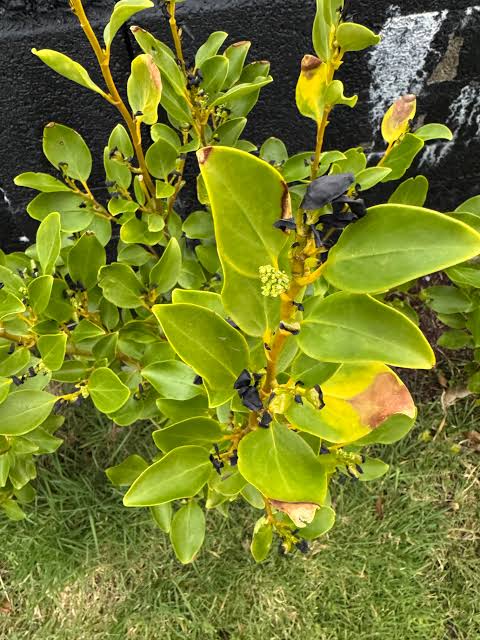
- brown or black marks on the leaves
- yellowing foliage
- dry, brown leaf edges
- leaves falling from sections of the hedge
- wilting despite apparently moist soil
- individual shoots dying back
- whole plants declining within the hedge
- sparse or unusually weak new growth
- dark or softened tissue around the stem base
- fungal growth around the roots or lower stems
Do not rely on one symptom alone. Brown foliage, for example, can be caused by frost, drought, wind scorch, damaged roots or disease.
Leaf spot on Griselinia
Leaf spot is one of the more commonly recognised diseases affecting Griselinia. It may be caused by different fungi or fungus-like organisms, and the appearance can vary slightly depending on the infection and growing conditions.
Affected leaves may develop:
- brown or black circular marks
- irregular dark patches
- spots with lighter or yellow margins
- several small spots that merge into larger damaged areas
- premature leaf drop
- weakened or marked new growth
Leaf spot is often more noticeable under mild, damp conditions, particularly when foliage remains wet for extended periods. Dense growth and poor airflow may also allow the problem to persist.
How to manage Griselinia leaf spot
We recommend beginning with practical hygiene and growing conditions rather than immediately reaching for a treatment.
Remove badly affected leaves and shoots where practical, then collect fallen foliage from beneath the hedge. Do not leave infected material trapped in dense growth, as this can keep the area damp and may contribute to the problem recurring.
Also check that:
- The hedge is not being watered over the foliage
- Air can move through and around the plants
- The soil is draining properly
- Mulch is not piled against the stems
- The hedge is not being repeatedly trimmed during wet conditions
- Cutting tools are clean before moving between affected and healthy areas
A lightly affected hedge will often produce healthy new foliage once the underlying conditions improve. Where the disease is severe, recurring or spreading rapidly, further diagnosis may be needed.