Is Yew poisonous to cattle?
Yes. Yew is highly poisonous to cattle.
Like horses, cattle may suffer severe or fatal poisoning after eating the foliage.
The danger is particularly high when animals gain access to:
- hedge trimmings
- fallen branches
- garden waste dumped in a field
- Yew growing through or over a fence
We would not recommend Yew as an accessible boundary around cattle.
Is Yew poisonous to sheep?
Yes. Sheep can also be poisoned by Yew.
Although susceptibility may vary between individual animals and species, there is no safe reason to allow sheep access to the plant.
Keep Yew:
- out of grazing areas
- away from feeding areas
- away from stored forage
- away from field entrances where garden waste might be deposited
Never assume sheep will instinctively avoid poisonous plants.
Is Yew poisonous to goats?
Yes. Yew is also unsafe for goats.
Goats are natural browsers and may investigate woody shrubs more readily than some other animals, making Yew particularly unsuitable where they can reach it.
A hedge that can be browsed through a fence is still a risk.
Branches should be well beyond reach, and cuttings must be removed completely.
Is Yew poisonous to chickens and poultry?
Yew should not be made accessible to poultry either.
Chickens and other birds may peck at unfamiliar plant material, fallen seeds or cut foliage.
Although serious poisoning is much more commonly associated with larger grazing animals, we recommend taking the same precautionary approach:
- do not plant Yew inside poultry runs
- do not dispose of clippings where birds forage
- remove fallen branches
- keep cut material out of reach
Is Yew poisonous to rabbits and guinea pigs?
Yes. Yew should be kept away from rabbits, guinea pigs and other small herbivorous pets.
These animals naturally chew plant material and may not distinguish between safe and poisonous foliage.
Never use Yew branches as enrichment, chew material or bedding.
If a rabbit or guinea pig is allowed to exercise freely in the garden, make sure it cannot reach a Yew hedge.
Is Yew poisonous to wildlife?
Yew is poisonous to many mammals if eaten, but it also has ecological value.
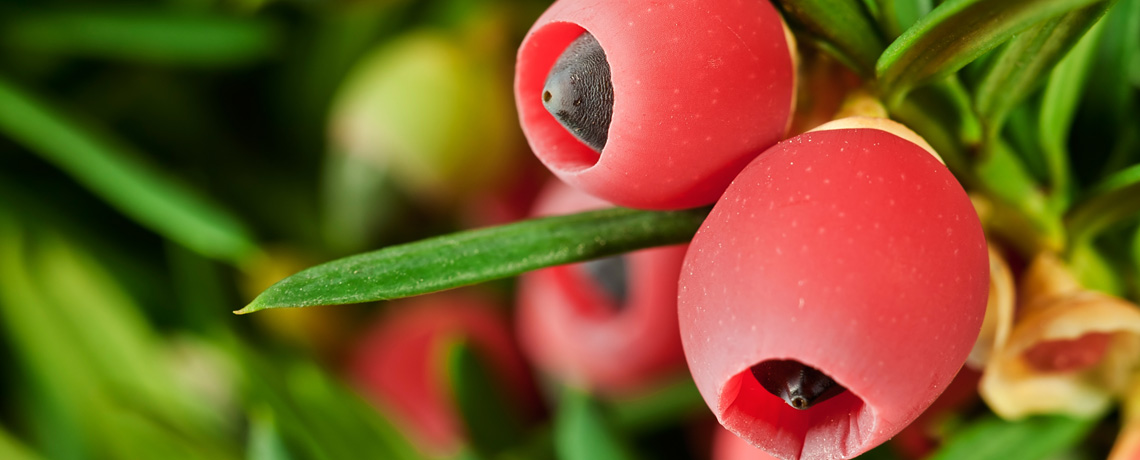
Birds commonly eat the red arils and disperse the seeds. The fleshy part of the fruit can be consumed, while the seed may pass through the digestive system intact.
Dense Yew growth can also provide valuable:
- shelter
- nesting cover
- winter protection
- habitat structure
This is a good example of why a plant can be both toxic and wildlife-friendly.
Toxicity to humans or livestock does not automatically mean a plant has no ecological value.