Beech or Hornbeam: What’s the Difference?

Beech or Hornbeam: What’s the Difference?

Beech and Hornbeam are two of the most popular deciduous hedging plants in the UK, and people often confuse them because they look very similar from a distance. Both can be clipped into neat formal hedges, both are hardy, and both can provide excellent screening through much of the year.

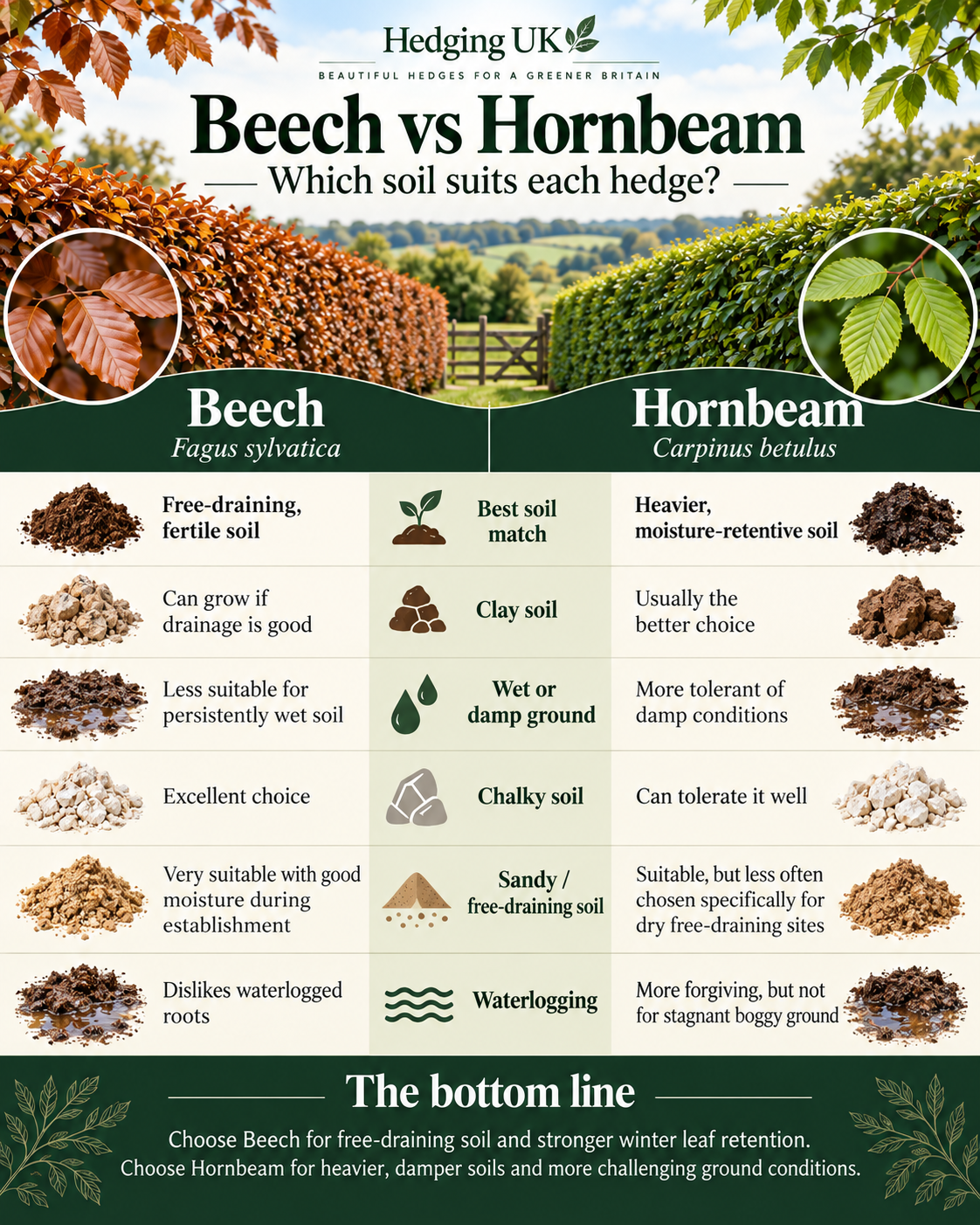
The main difference lies in the conditions they prefer and how they behave in winter. Beech generally prefers free-draining soil and tends to hold its brown leaves for longer through winter, while Hornbeam copes better with heavier, wetter soils and colder, more exposed conditions.

For many gardens, either will work well. The best choice depends on the soil, moisture levels, exposure, and the look you want.

Beech and Hornbeam at a glance

The two plants share a lot, but a few key differences are worth remembering.

Beech

Beech, or Fagus sylvatica, is usually the better choice where:

  • the soil drains freely
  • the site is not persistently wet
  • winter leaf retention is important
  • you want a smooth, formal-looking hedge
  • you prefer warmer copper-brown winter colour

Hornbeam

Hornbeam, or Carpinus betulus, is often the better option where:

  • the soil is heavier
  • the site stays damper
  • the garden is colder or more exposed
  • frost pockets are a concern
  • you need a hedge that is slightly more tolerant of difficult conditions

Are Beech and Hornbeam the same plant?

No.

Although they look similar and serve the same purpose, Beech and Hornbeam are completely different species.

Beech belongs to the genus Fagus, while Hornbeam belongs to Carpinus.

They aren’t interchangeable just because the leaves look alike. Their growing preferences differ enough that choosing the wrong one for the site can result in an unnecessarily struggling hedge.

What does a Beech hedge look like?

Beech has smooth, oval leaves with gently wavy edges.

New foliage emerges a bright, fresh green in spring, deepens through summer, and turns shades of yellow, orange, copper, and brown in autumn.

One of the main attractions of Beech hedging is that young and regularly clipped plants often retain their dead brown leaves through winter.

This gives the hedge:

  • additional privacy
  • attractive winter colour
  • structure even after the growing season
  • a fuller appearance than many other deciduous hedges

New growth usually pushes the old leaves off as spring arrives.

What does a Hornbeam hedge look like?

Hornbeam leaves are similar in overall shape but are more strongly ribbed or corrugated.

The edges are more noticeably toothed, and the leaf surface often looks more textured than Beech.

Hornbeam foliage is fresh green through spring and summer before turning yellow and brown in autumn.

It can also retain some dead leaves through winter when regularly clipped, but generally not as consistently or for as long as Beech.

If winter screening is your main priority, Beech normally has the edge.

How can you tell Beech and Hornbeam leaves apart?

The easiest way is to look closely at the texture and leaf edge.

Beech leaves tend to be:

  • smoother
  • shinier
  • less deeply ribbed
  • gently wavy around the edge

Hornbeam leaves tend to be:

  • more deeply ribbed
  • more textured
  • visibly serrated or toothed around the edge
  • slightly rougher in appearance

Once you know what to look for, the difference becomes fairly easy to spot.

Which keeps its leaves better in winter?

Beech usually retains its dead leaves better than Hornbeam when grown as a clipped hedge.

This retention of dead leaves is called marcescence.

Instead of dropping everything in autumn, many clipped Beech hedges hold onto their dry, copper-brown foliage until new leaves appear in spring.

Hornbeam can also retain leaves, especially on younger growth, but it usually sheds more of them through winter.

If winter privacy is particularly important, we would normally favour Beech.

Are Beech and Hornbeam evergreen?

No. Both are deciduous.

They grow fresh leaves in spring, and the foliage dies back in autumn.

The reason Beech sometimes appears almost evergreen from a distance is that clipped plants often hold onto their dead leaves for much of the winter.

These leaves are brown, not living green foliage.

Neither plant provides the same year-round green coverage as Yew, Laurel or another true evergreen hedge.

Which Hedge is better for wet soil?

Hornbeam.

This is one of the most important differences between the two.

Beech prefers soil that is moist but free-draining. It does not perform well where the roots remain waterlogged for long periods.

Hornbeam tolerates heavier, damper ground, making it a better choice for many clay soils and gardens that stay wet through winter.

That doesn’t mean Hornbeam wants to grow in permanently boggy conditions, but it is generally more forgiving where drainage isn’t perfect.

If you have heavy ground and are unsure which to choose, Hornbeam is usually the safer option.

Which Hedge is better for dry soil?

Beech can tolerate reasonably dry conditions once established, but it does not like prolonged drought.

Young plants in particular need consistent moisture while their roots establish.

Hornbeam is also adaptable, but where the soil is naturally free-draining and not excessively dry, either species can perform well.

On very dry, shallow or drought-prone soil, we would consider improving the soil and ensuring reliable watering during establishment, whichever plant you choose.

Which Hedge is better for clay soil?

Hornbeam is usually our first choice for heavy clay.

It copes better with moisture and heavier ground than Beech.

Beech can grow in clay with good drainage, but if the site regularly becomes saturated in winter, Hornbeam is more dependable.

Before planting either species, we recommend checking how the soil behaves after heavy rain rather than judging the soil type alone.

Good clay soil with reasonable drainage can support Beech perfectly well.

Cold, compacted, waterlogged clay is a different matter.

Which is better for chalky soil?

Beech is an excellent choice for chalky ground.

It grows well on free-draining chalk and limestone soils and often thrives in naturally chalky landscapes.

Hornbeam can also tolerate chalk.

Where both plants are suitable, the choice can therefore come down more to appearance and winter leaf retention.


Beech or Hornbeam, What's the difference? Soil Type Guide

Which is better for cold or exposed gardens?

Hornbeam generally performs better in colder or more exposed conditions.

It is particularly useful for:

  • frost-prone gardens
  • cold inland sites
  • exposed rural boundaries
  • heavier soils in colder regions

Beech is also hardy, but late frost can damage its young leaves, and it tends to be slightly less forgiving in cold, wet conditions.

If your garden sits in a frost pocket or regularly experiences harsh winter conditions, Hornbeam is often the more reliable choice.

Which grows faster?

Both are moderate-growing hedges and can typically grow about 30–45cm per year once established in suitable conditions.

Actual growth depends on:

  • soil
  • moisture
  • light
  • plant size
  • establishment
  • pruning
  • competition
  • weather

Hornbeam may sometimes appear more vigorous on difficult heavy ground simply because it is better suited to the conditions.

On good free-draining soil, Beech can grow just as strongly.

Don’t choose either purely on growth rate, because long-term performance depends more on matching the plant to the site.

Which makes the denser hedge?

Both can make a very dense hedge when planted and trimmed properly.

Beech often produces a particularly smooth, formal finish and holds winter leaves very well.

Hornbeam also thickens strongly and responds well to regular clipping.

Density is influenced by:

  • planting spacing
  • formative pruning
  • light
  • hedge shape
  • soil conditions
  • watering during establishment

A well-planted Hornbeam hedge is usually much denser than a struggling Beech hedge planted in unsuitable, wet ground.

Which is better for privacy?

Both are excellent for privacy during spring, summer and autumn.

For winter privacy, Beech generally performs better because it retains more of its dead foliage.

A regularly clipped Beech hedge can remain surprisingly full through winter, even though the leaves have turned copper brown.

Hornbeam tends to lose more leaves as winter progresses.

If you need complete green screening all year, however, neither is truly evergreen. In that situation, consider Yew, Laurel or another evergreen species.

Do Beech and Hornbeam grow in shade?

Both will tolerate partial shade.

They usually perform best in:

  • full sun
  • light shade
  • partial shade

Deep shade will reduce density and autumn colour.

Beech generally produces the strongest foliage colour in good light.

Purple or Copper Beech needs particularly good sunlight to develop its best colour.

Hornbeam can be a little more forgiving in difficult conditions.

Which has the better autumn colour?

This largely depends on taste.

Beech usually develops:

  • golden yellow
  • orange
  • copper
  • russet brown

Hornbeam tends towards:

  • yellow
  • gold
  • brown

Beech generally provides a warmer, richer autumn display and then retains those copper-brown leaves through much of winter.

Hornbeam usually has a slightly more natural woodland appearance.

What about Copper Beech?

Copper Beech is a purple-leaved form of Beech and can make an exceptional hedge.

Its foliage can range from:

  • deep purple
  • burgundy
  • bronze
  • copper

It provides much stronger colour contrast than standard green Beech.

Copper Beech prefers a bright position, as good sunlight helps develop the richest foliage colour.

It has broadly similar soil requirements to green Beech, so it still prefers free-draining ground rather than wet conditions.

Which is easier to maintain?

There is very little difference.

Both respond well to annual trimming and can be maintained at a wide range of heights.

For most established hedges, a main trim in late summer works well.

Young plants benefit from formative pruning so they develop a dense framework from the base.

Neither is particularly demanding once established.

When should Beech and Hornbeam hedges be trimmed?

For routine maintenance, late summer is usually ideal.

An annual trim around August allows you to:

  • maintain the required size
  • encourage density
  • keep a formal outline
  • help Beech retain more winter foliage

Young hedges may need additional formative pruning while they establish.

Renovation of older hedges usually happens during the dormant period.

Can Beech and Hornbeam be cut back hard?

Both respond much better to hard pruning than many evergreen hedges.

An old, overgrown hedge can often be:

  • lowered
  • narrowed
  • reshaped
  • renovated

Where major work is required, we recommend staged renovation rather than removing everything at once.

Beech in particular can resent severe pruning as a mature tree, but a maintained hedge is generally much more forgiving.

Beech vs Hornbeam: which should you choose?

Choose Beech if:

  • your soil drains well
  • winter leaf retention matters
  • you want a particularly smooth formal hedge
  • you like copper-brown winter foliage
  • the site is not severely frost-prone
  • the ground does not stay wet

Choose Hornbeam if:

  • your soil is heavy or clay-based
  • the site stays damp
  • your garden is cold or exposed
  • you are planting in a frost pocket
  • you want a tough, adaptable native hedge
  • Beech is likely to struggle with the conditions

If both will grow well on your site, the choice becomes more about appearance.

Quick comparison

Beech or Hornbeam, What's the difference?

Final thoughts

Beech and Hornbeam are both excellent hedge plants, and visually they can be remarkably similar. The key difference isn’t how they look, but the conditions in which they perform best.

For a well-drained garden where winter screening and rich copper foliage are important, Beech is usually the better choice.

For heavy clay, damper ground, frost pockets or colder exposed locations, Hornbeam is often the more reliable option.

If you are unsure which to choose, look at the soil first. A hedge planted in conditions that suit it will always perform better than one selected purely on appearance.

Both species respond beautifully to regular clipping and can create dense, long-lived hedges with excellent seasonal character. Choosing between them simply means matching the plant to your garden.