How far apart should Yew trees be planted for a hedge.

How Far Apart Should Yew Trees Be Planted for a Hedge?

Getting the spacing right is one of the most important parts of planting a Yew hedge. Plant too far apart and you may be waiting years for the gaps to close. Plant too close together and the plants can end up competing unnecessarily for water, nutrients and root space.

For most Yew hedges, we recommend planting at around 30–60cm apart, depending on the size of the plants and how quickly you want the hedge to fill. Smaller bare-root or young plants are usually planted more closely, while larger pot-grown or root-balled Yews can be spaced further apart.

The aim is to give each plant enough room to develop while still allowing neighbouring plants to knit together into one dense, continuous hedge.

What is the best spacing for a Yew hedge?

As a general guide, we recommend:

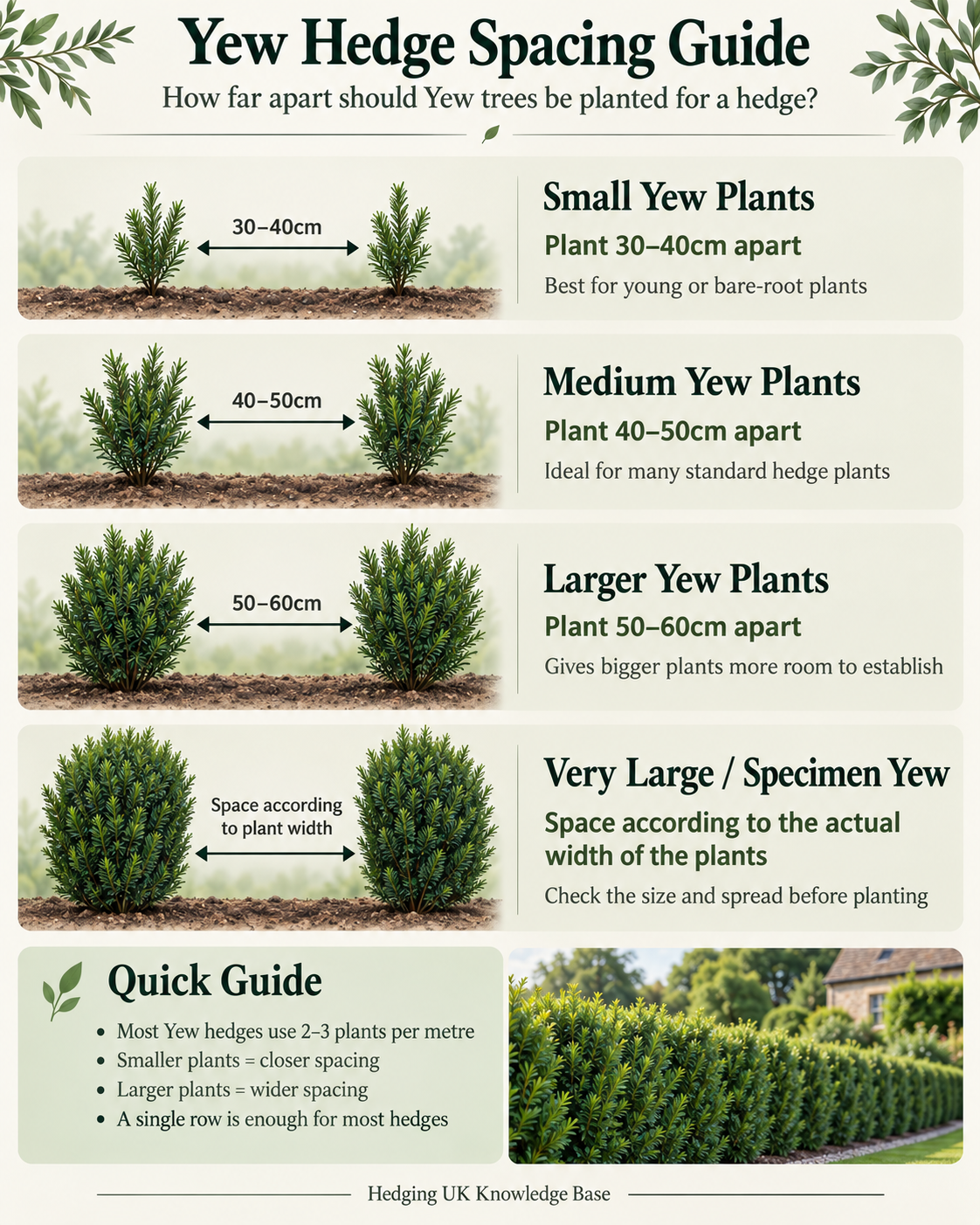
  • Small bare-root or young Yew plants: around 30–40cm apart
  • Medium pot-grown Yew plants: around 40–50cm apart
  • Larger, well-established plants: around 50–60cm apart
  • Very large or semi-mature Yews: spacing should be based on the actual width of the plants supplied

For many standard domestic Yew hedges, 2–3 plants per metre works well.

The exact spacing should always reflect the size and shape of the plants rather than relying on a single figure for every hedge.

How many Yew plants do I need per metre?

A useful working guide is:

Spacing Approximate plants per metre
30cm apart 3–4 plants
40cm apart 2.5 plants
50cm apart 2 plants
60cm apart Around 1.5–2 plants

For a typical formal Yew hedge, we would usually expect 2–3 plants per metre.

Closer planting can provide quicker visual coverage, but overcrowding larger plants offers no benefit.

Does the size of the Yew plants matter?

Yes, very much.

A small 40cm bare-root Yew and a broad 1.2m pot-grown Yew should not be planted at the same spacing.

Smaller plants have:

  • narrower crowns
  • smaller root systems
  • more open space between them
  • longer to grow before neighbouring branches meet

Larger plants are already wider and occupy more space, so they usually need to be set further apart.

We recommend looking at both height and width before deciding on spacing. Two plants of the same height can have very different levels of bushiness.

How far apart should small Yew plants be?

For smaller bare-root or young Yew plants, start with around 30–40cm apart.

This works particularly well where:

  • the plants are around 40–60cm tall
  • a dense hedge is wanted relatively quickly
  • formative pruning will be carried out from the start
  • the planting strip has been prepared properly

Young Yew often establishes well because its smaller root system adapts quickly to the surrounding soil.

Closer planting at this stage helps the hedge knit together without creating excessive crowding later.

How far apart should 60–90cm Yew plants be?

For plants around 60–90cm high, we would generally suggest around 40–50cm apart.

This gives enough room for healthy root development while still allowing the hedge to fill reasonably quickly.

At this spacing, you will usually need around 2–2.5 plants per metre.

If the plants are particularly bushy, a slightly wider spacing may be perfectly adequate.

How far apart should larger Yew plants be?

For larger Yew plants, particularly those over 1 metre high, we would normally increase the spacing to around 50–60cm, sometimes more for especially broad specimens.

Large plants need:

  • more root space
  • greater soil volume
  • reliable watering
  • room for their existing branches
  • good airflow

Packing large root balls too tightly together does not create a better hedge. It can simply increase competition and make establishment more difficult.
How far apart should Yew trees be planted for a hedge. Yew Hedge Spacing Guide

What happens if Yew is planted too far apart?

If plants are spaced too widely, the main problem is time.

You may see:

  • open gaps for several years
  • reduced privacy
  • individual plants developing as separate shrubs
  • an uneven hedge line
  • slower visual impact

This does not necessarily mean the hedge will fail.

Healthy Yew will gradually spread and fill the available space, but because Yew grows more steadily than some faster hedge species, the process can take time.

Formative side trimming encourages branching and can speed up how plants knit together.

What happens if Yew is planted too close together?

Planting too close together may create an instant dense appearance, but it has disadvantages.

Overcrowded plants compete for:

  • water
  • nutrients
  • root space
  • light

This is particularly important while the hedge is establishing.

Too many plants can also make the hedge unnecessarily broad and congested later.

Aim for good spacing for long-term health rather than maximum density on planting day.

Will closer planting make a Yew hedge grow faster?

Closer spacing will make the hedge look fuller sooner, but it will not make the individual plants grow faster.

In fact, excessive competition can reduce vigour.

The best way to establish a Yew hedge quickly is to combine:

  • sensible spacing
  • good soil preparation
  • regular watering
  • mulch
  • weed control
  • formative pruning
  • patience

A healthy plant with room to establish will usually outperform an overcrowded one in the long term.

Single row or double row?

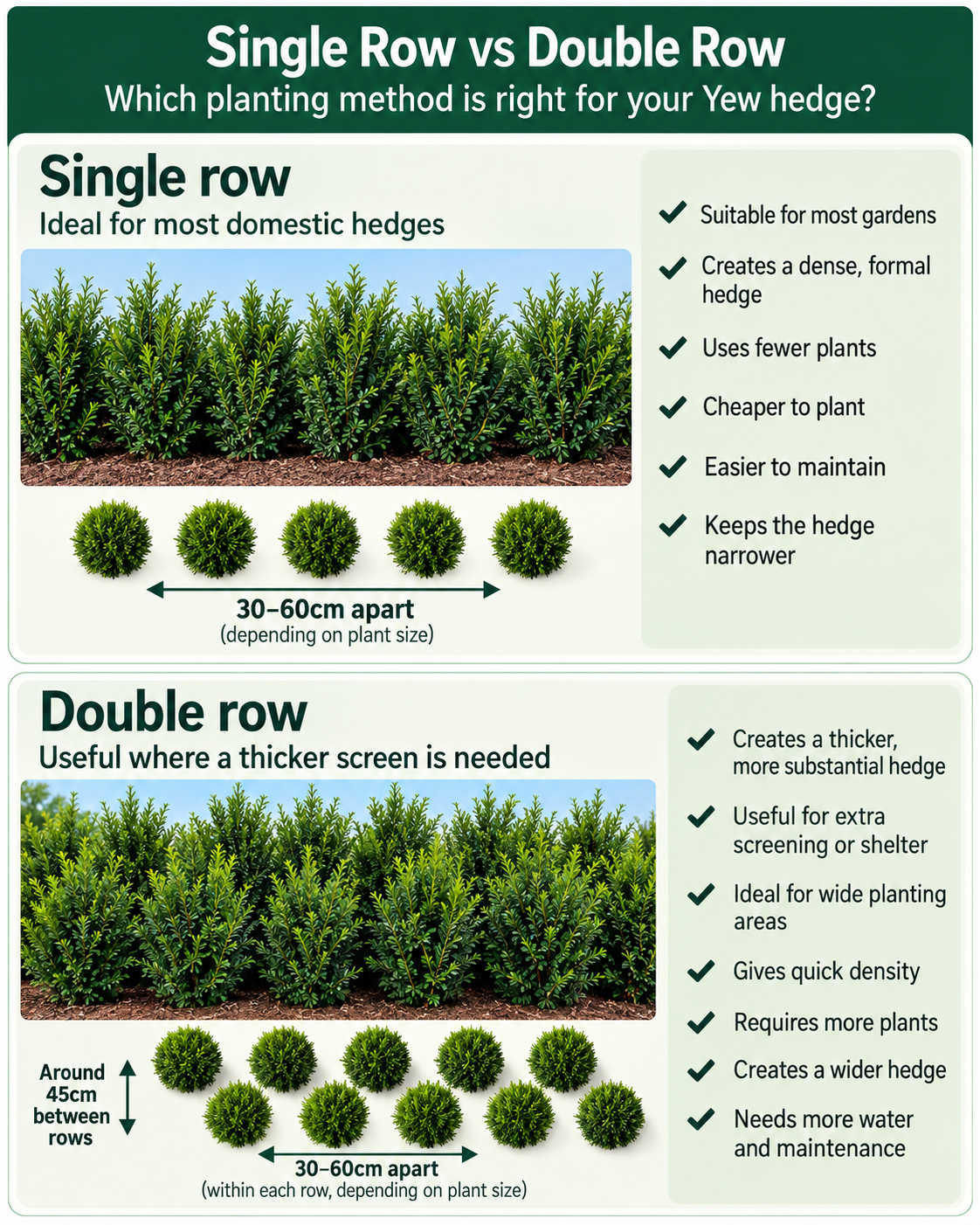
For most domestic Yew hedges, a single row is more than adequate.

A properly spaced single row can develop into a very dense evergreen screen.

It is also:

  • cheaper
  • easier to plant
  • easier to water
  • easier to mulch
  • easier to maintain
  • less likely to become excessively wide

A double row is rarely necessary for an ordinary garden boundary.

When would you use a double row?

A staggered double row may be useful where:

  • an unusually thick screen is required
  • the hedge is being used as a substantial shelter belt
  • the planting area is very wide
  • rapid density is more important than keeping the hedge narrow

For a double row, allow around 45cm between the rows, staggering the plants rather than placing them directly opposite one another.

The exact spacing within the row should still reflect plant size.

Remember that a double row creates a much broader hedge and requires more plants, more water, and more maintenance.

How far apart should Yew trees be planted for a hedge. Single row Vs Double Row planting

How far apart should Yew be planted from a fence?

Do not plant Yew directly against a fence.

Although the hedge may look small at first, it needs enough space to develop its final width.

When deciding where to put the planting line, consider:

  • the intended finished width
  • access for trimming
  • airflow
  • whether the rear of the hedge will receive any light
  • whether the fence creates dry soil or a rain shadow

If you want a hedge around 80cm wide, allow enough room on either side of the centre line for it to develop to that width.

How far should Yew be planted from a wall?

The same principle applies to walls.

Leave enough room for:

  • root development
  • hedge width
  • future trimming
  • airflow
  • access for watering

Walls can also make the soil immediately beside them surprisingly dry, especially beneath overhanging eaves.

Monitor moisture carefully during establishment.

How far should Yew be planted from a path or driveway?

Always plan for the finished hedge width, not just the size of the plants on planting day.

If you plant the hedge immediately beside a path, it may quickly grow across it and need constant trimming.

Set the centre line back far enough that the mature hedge can develop without obstructing:

  • footpaths
  • driveways
  • gateways
  • vehicle access

This becomes especially important if you intend to maintain a tall Yew hedge, because taller hedges need enough base width to stay dense and balanced.

Does the finished height affect spacing?

To some extent, yes.

A low decorative hedge and a tall privacy hedge don’t necessarily need the same planting density.

However, starting plant size remains the biggest factor.

For a tall Yew hedge, we prefer to give plants enough room to establish strongly and use formative pruning to create density rather than simply squeezing extra plants into the space.

A healthy root system is essential if the hedge is expected to support several metres of growth over time.

How quickly will the gaps between Yew plants close?

Yew can typically grow around 20–30cm per year once established and growing well.

How quickly gaps disappear depends on:

  • starting plant size
  • planting distance
  • soil quality
  • light
  • water
  • competition
  • pruning

Young plants may not reach their maximum growth in the first season because they focus on root establishment.

Once settled, side growth will gradually connect neighbouring plants.

Regular formative trimming encourages branching and helps create a dense hedge rather than simply tall individual plants.

Should you cut Yew after planting to help it fill out?

Light formative pruning can help.

We recommend:

  • removing damaged shoots
  • shortening long or uneven side growth
  • encouraging branching
  • allowing the main upright leader to continue until the hedge approaches its required height

Do not repeatedly cut across the top of a young hedge if it still needs to gain height.

The aim is to build density through the sides while still allowing upward growth.

How to calculate how many Yew plants you need

First, measure the total length of the hedge.

Then multiply by the chosen planting density.

For example:

  • 5m hedge at 2 plants per metre = 10 plants
  • 5m hedge at 3 plants per metre = 15 plants
  • 10m hedge at 2 plants per metre = 20 plants
  • 10m hedge at 3 plants per metre = 30 plants

If the total doesn’t divide neatly, space the plants evenly across the entire length.

Do not leave the odd extra gap at one end.

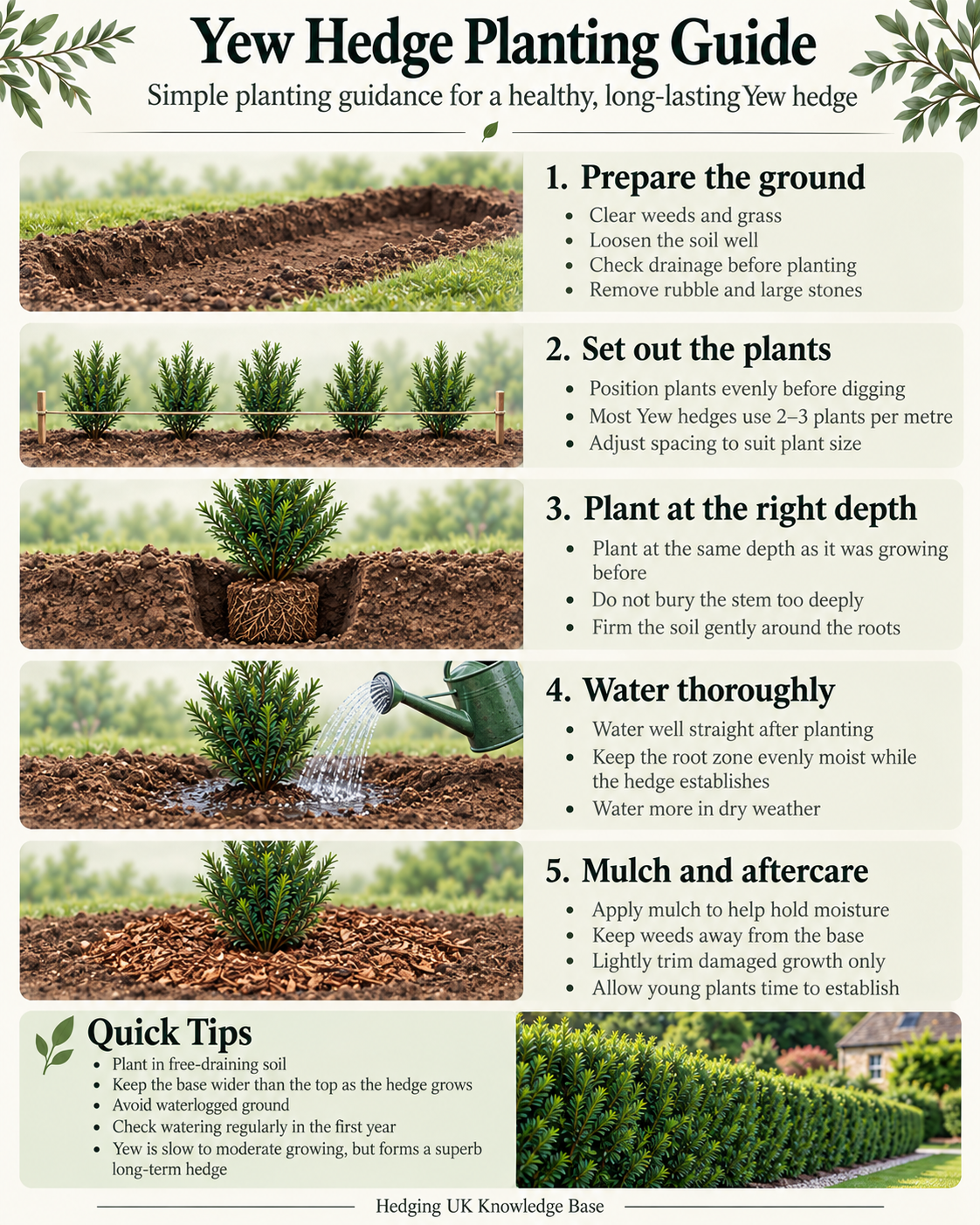
Set the plants out before digging

We always recommend laying the plants out along the hedge line before planting.

This lets you check:

  • overall spacing
  • whether the end gaps are even
  • changes in plant width
  • corners
  • obstacles
  • access

Use a string line to keep the hedge straight and mark each planting position.

A little planning before digging makes the finished hedge look much more professional.

Does Yew need a wide planting trench?

For a hedge, it’s usually better to prepare the entire planting strip than to dig a series of narrow holes in compacted soil.

A broad prepared trench gives the roots better access to the surrounding ground.

We recommend:

  • removing weeds and turf
  • loosening compacted soil
  • checking drainage
  • removing building rubble
  • preparing enough width for roots to spread naturally

Yew dislikes waterlogged ground, so drainage is especially important.

In heavy soils, improving the wider planting area is better than creating isolated pockets of soft soil that fill with water.

How far apart should Yew trees be planted for a hedge. Planting a Yew

Bare-root Yew spacing

Bare-root Yew is often supplied as relatively young plants and is particularly suitable for creating longer hedge runs economically.

You can usually position these plants about 30–40cm apart.

Because they are smaller, they establish well and can be trained early.

Keep bare roots moist while planting, and never let them dry out before they go into the ground.

Pot-grown Yew spacing

Pot-grown Yew varies much more in size.

For medium plants, around 40–50cm apart is often suitable.

For larger pot-grown specimens, increase the distance according to their actual width.

Don’t assume a larger pot means the plants should be crammed closer together for instant screening.

Larger roots need more room and more water during establishment.

Root-balled Yew spacing

Larger Yew is sometimes supplied root-balled.

These plants are already relatively mature and can give a much stronger initial effect.

Spacing is usually wider than for small bare-root plants, often 50–60cm or more, depending on the plant width.

The plants’ exact specifications should guide the final layout.

How close can Yew be planted to other trees and hedges?

Established trees and hedges can compete for water and nutrients.

Where possible, leave adequate distance from existing large plants.

A newly planted Yew beside an established tree may struggle because the mature roots take:

  • water
  • nutrients
  • root space

If you can’t avoid planting nearby, the new hedge may need more careful watering and soil preparation.

Common Yew hedge spacing mistakes

The most common mistakes include:

  • using the same spacing for every plant size
  • planting small plants too widely
  • overcrowding large specimens
  • planting directly against fences
  • forgetting to allow for finished width
  • choosing a double row where a single row is enough
  • failing to set the row out before planting
  • expecting very wide spacing to provide quick privacy
  • assuming maximum plant numbers mean maximum growth

Good spacing should balance initial coverage with long-term plant health.

Final thoughts

For most Yew hedges, planting around 30–60cm apart gives the best balance between quick coverage and healthy long-term growth.

Position smaller plants toward the closer end of that range, while larger, bushier specimens need more room.

For many domestic hedges, around 2–3 plants per metre works well.

Avoid overcrowding simply to achieve instant coverage. Yew is naturally dense and responds extremely well to formative pruning, so correctly spaced plants will gradually grow together into a solid evergreen hedge.

Measure the full planting run, set the plants out before digging, and allow enough room for the finished width and the roots. Done properly, a Yew hedge can become a dense, long-lived boundary that stays manageable for many years.